
Inventory management has always required retailers to balance two competing priorities: keeping enough products in stock to meet customer demand while avoiding excess inventory that ties up capital and eventually becomes waste. Achieving this balance has become increasingly difficult as product assortments expand, customer demand becomes less predictable, and omnichannel fulfillment introduces additional complexity into inventory planning.
Holding too much inventory creates significant operational challenges. Slow-moving products occupy valuable warehouse space, increase storage costs, and often require markdowns to clear unsold stock. In industries such as grocery, fashion, cosmetics, and consumer electronics, excess inventory may become obsolete or expire before it can be sold, directly impacting profitability. At the same time, maintaining inventory levels that are too low increases the risk of stockouts, lost sales, disappointed customers, and long-term damage to brand loyalty.
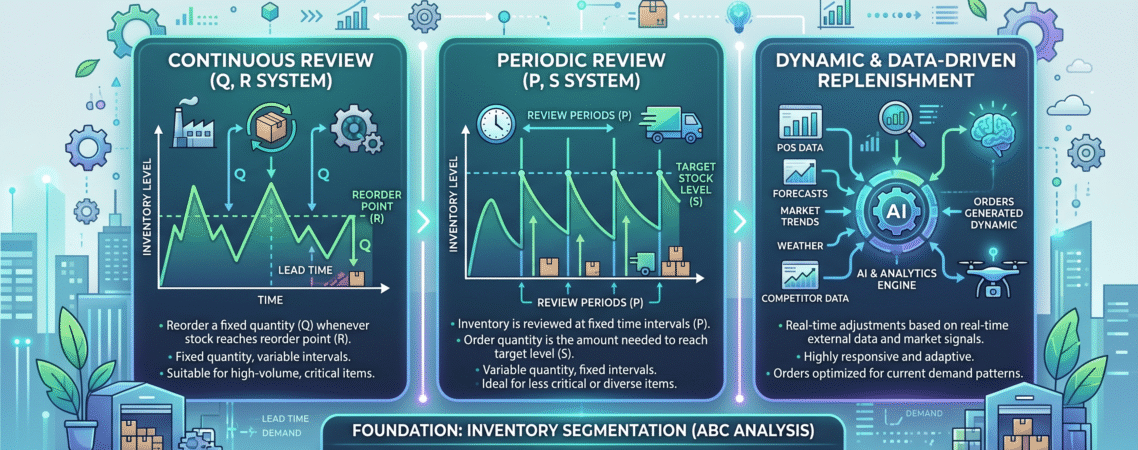
Traditional replenishment methods often rely on historical sales averages, fixed reorder points, and manual forecasting. While these approaches may work during stable demand periods, they struggle to respond to changing customer behavior, seasonal fluctuations, supply chain disruptions, and regional demand differences.
Predictive replenishment tool offer a more intelligent solution. Powered by artificial intelligence (AI), machine learning, predictive analytics, and real-time demand sensing, these platforms continuously evaluate customer demand, inventory levels, supplier performance, and external market signals to recommend optimal replenishment decisions. Instead of simply minimizing inventory or maximizing availability, predictive replenishment helps retailers achieve both objectives simultaneously by reducing inventory waste while maintaining consistently high product availability.
Why Inventory Balance Matters
Inventory directly affects both customer satisfaction and business profitability.
Retailers must balance:
- Product availability
- Inventory investment
- Storage costs
- Fulfillment efficiency
- Customer demand
Maintaining this balance becomes increasingly difficult as retail operations grow more complex.
The Cost of Inventory Waste
Excess inventory creates financial and operational challenges.
Common consequences include:
- Higher carrying costs
- Warehouse congestion
- Product markdowns
- Inventory obsolescence
- Product expiration
- Working capital constraints
Inventory waste reduces profitability while limiting operational flexibility.
The Cost of Stockouts
Reducing inventory too aggressively introduces a different set of risks.
Stockouts often result in:
- Lost sales
- Poor customer experiences
- Lower customer loyalty
- Emergency replenishment costs
- Missed promotional opportunities
Retailers therefore need inventory strategies that reduce waste without sacrificing availability.
The Limitations of Traditional Replenishment
Many organizations continue to rely on:
- Historical sales averages
- Fixed reorder points
- Static safety stock
- Manual forecasting
Although familiar, these methods often fail to respond quickly to changing market conditions.
Common limitations include:
Delayed Response to Demand Shifts
Historical data may not reflect current purchasing behavior.
Overstocking
Static replenishment rules often create unnecessary inventory.
Inaccurate Forecasts
Manual forecasting becomes increasingly difficult across large product assortments.
Limited Supply Chain Visibility
Disconnected systems reduce planning accuracy.
These limitations increase both waste and stockout risk.
What Are Predictive Replenishment Tools?
Predictive replenishment tools use AI, machine learning, predictive analytics, and real-time demand signals to optimize inventory decisions.
These systems evaluate information such as:
- Sales transactions
- Customer behavior
- Inventory levels
- Supplier performance
- Seasonal demand
- Market trends
The objective is to replenish inventory based on expected future demand rather than relying solely on historical patterns.
How Predictive Replenishment Reduces Inventory Waste
Improving Demand Forecast Accuracy
Accurate forecasting reduces unnecessary inventory.
Predictive replenishment systems analyze:
- Historical sales
- Seasonal trends
- Promotional calendars
- Customer behavior
- External demand signals
Machine learning continuously refines forecasts as new information becomes available.
More accurate forecasts reduce excess inventory while maintaining service levels.
Leveraging Real-Time Demand Sensing
Customer demand changes rapidly.
Predictive replenishment platforms monitor:
- Point-of-sale transactions
- Ecommerce purchases
- Product searches
- Website traffic
- Cart activity
These real-time signals enable retailers to adjust replenishment before demand shifts become inventory problems.
Optimizing Inventory Allocation
Inventory waste often results from placing products in the wrong locations.
Predictive replenishment evaluates:
- Store demand
- Distribution center inventory
- Fulfillment center capacity
- Regional buying patterns
Products are allocated where they are most likely to sell.
This improves inventory productivity while reducing excess stock.
Dynamic Safety Stock Management
Traditional safety stock remains relatively fixed.
Predictive replenishment continuously adjusts safety stock according to:
- Demand variability
- Supplier lead times
- Forecast confidence
- Service level targets
Dynamic safety stock reduces unnecessary inventory while maintaining product availability.
Identifying Slow-Moving Inventory
AI continuously monitors inventory performance.
Predictive analytics identifies:
- Declining demand
- Low inventory turnover
- Overstocked products
- Seasonal inventory risks
Retailers can respond before inventory becomes obsolete.
Supporting Perishable Inventory
Retailers selling food, pharmaceuticals, cosmetics, or other time-sensitive products must minimize expiration-related losses.
Predictive replenishment helps align replenishment with actual consumption rates.
This reduces spoilage while maintaining shelf availability.
Improving Supplier Collaboration
Inventory performance depends heavily on supplier responsiveness.
Predictive replenishment tools improve collaboration by sharing:
- Forecast demand
- Inventory requirements
- Replenishment schedules
- Supplier performance metrics
Better coordination improves inventory efficiency across the supply chain.
Supporting Omnichannel Fulfillment
Inventory now supports multiple fulfillment channels, including:
- Physical stores
- Ecommerce
- Buy Online, Pick Up In Store (BOPIS)
- Ship-from-store
- Home delivery
Predictive replenishment optimizes inventory across all fulfillment models without creating unnecessary duplication.
Responding Faster to Market Changes
Unexpected events can significantly alter demand.
Examples include:
- Weather changes
- Local events
- Viral product trends
- Supply chain disruptions
Predictive replenishment systems identify these shifts early and recommend inventory adjustments before stockouts or overstock situations develop.
AI Improves Inventory Decision-Making
Artificial intelligence processes large volumes of operational data far more efficiently than manual planning.
AI can:
- Predict demand fluctuations
- Recommend replenishment quantities
- Optimize inventory positioning
- Identify waste risks
Machine learning improves decision quality as more operational data becomes available.
Enhancing Inventory Visibility
Effective replenishment depends on end-to-end visibility.
Retailers benefit from visibility into:
- Current inventory
- Inventory in transit
- Supplier lead times
- Future demand forecasts
- Open purchase orders
Comprehensive visibility supports more informed replenishment decisions.
Benefits of Predictive Replenishment
Lower Inventory Waste
Retailers reduce excess inventory and markdowns.
Higher Product Availability
Customers find products in stock more consistently.
Better Forecast Accuracy
AI improves replenishment planning.
Reduced Carrying Costs
Inventory investments become more efficient.
Improved Customer Satisfaction
Reliable product availability strengthens customer trust.
Greater Operational Efficiency
Automation reduces manual planning effort.
Common Challenges Retailers Face
Demand Volatility
Customer preferences change rapidly.
Fragmented Data
Inventory information often resides across disconnected systems.
Supply Chain Disruptions
Supplier performance may fluctuate unexpectedly.
Technology Integration
Replenishment systems must exchange data across multiple platforms.
Addressing these challenges is essential for effective inventory optimization.
Best Practices for Reducing Inventory Waste
Use AI-Powered Forecasting
Machine learning improves demand prediction accuracy.
Capture Real-Time Demand Signals
Current customer behavior strengthens replenishment decisions.
Optimize Inventory Across the Entire Network
Treat inventory as a shared enterprise resource.
Strengthen Supplier Collaboration
Shared planning improves replenishment efficiency.
Continuously Monitor Inventory Performance
Ongoing optimization reduces waste while maintaining availability.
Key Metrics to Track
Organizations should monitor:
- Forecast accuracy
- Inventory turnover
- Stockout rate
- Inventory carrying cost
- Fill rate
- Days of inventory on hand
- Inventory waste and markdown rate
These metrics help measure the effectiveness of predictive replenishment strategies.
Conclusion
Reducing inventory waste and maintaining product availability are often viewed as competing objectives, but modern replenishment technology makes it possible to achieve both simultaneously. Instead of relying on static rules and historical averages, retailers can use predictive replenishment tools to make smarter inventory decisions based on real-time demand, AI-driven forecasting, and continuous operational intelligence.
By combining machine learning, predictive analytics, unified inventory visibility, and real-time demand sensing, predictive replenishment helps businesses minimize excess stock, reduce carrying costs, prevent stockouts, and improve customer satisfaction. The result is a more efficient, resilient, and profitable supply chain that can adapt quickly to changing market conditions.
As retail operations continue to grow in complexity, predictive replenishment will remain a critical capability for organizations seeking to optimize inventory performance, reduce waste, and deliver consistent product availability across every channel.


