
Search is one of the most influential touchpoints in the ecommerce customer journey. Shoppers who use search often have clear purchase intent and expect to find relevant products within seconds. If search results fail to understand what they mean or return irrelevant products, frustration grows quickly, increasing the likelihood that customers will abandon the site and look elsewhere.
Traditional ecommerce search engines were designed around keyword matching. They compared the words entered by a shopper with product titles, descriptions, and metadata. While this approach worked reasonably well for simple queries, it often struggled with natural language, synonyms, misspellings, abbreviations, and intent. A customer searching for “running shoes for flat feet” expects products designed for stability and support, not simply every item containing the words “running” and “shoes.” Likewise, someone searching for “office chair for back pain” is looking for ergonomic solutions rather than generic office seating.
Semantic search addresses these limitations by focusing on the meaning behind a query instead of just matching keywords. Powered by artificial intelligence (AI), natural language processing (NLP), machine learning, and behavioral analytics, semantic search understands relationships between words, customer intent, and product attributes. When combined with ecommerce search personalization, retailers can deliver search experiences that adapt to each individual shopper while supporting merchandising goals and improving product discovery.
As product catalogs continue to grow and customer expectations rise, semantic search is becoming a critical capability for retailers looking to improve search performance, increase conversions, and create more intelligent shopping experiences.
Why Search Matters in Ecommerce
Search users often demonstrate stronger purchase intent than casual browsers.
Customers use search to:
- Find specific products
- Compare alternatives
- Narrow product choices
- Solve a particular problem
The quality of search results has a direct impact on customer satisfaction, conversion rates, and revenue.
The Limitations of Keyword-Based Search
Traditional search engines primarily rely on matching exact words.
Although straightforward, this approach creates several challenges.
Limited Understanding of Intent
Keyword matching cannot determine what customers actually mean.
Difficulty Handling Natural Language
Customers increasingly use conversational search queries.
Poor Synonym Recognition
Different customers describe the same products in different ways.
Misspellings and Typographical Errors
Exact matching often fails when queries contain spelling mistakes.
Weak Product Discovery
Relevant products may remain hidden because they use different terminology.
These issues create friction throughout the shopping experience.
What Is Semantic Search?
Semantic search is an AI-powered search approach that understands the meaning, context, and intent behind customer queries.
Instead of focusing only on individual keywords, semantic search evaluates:
- Customer intent
- Word relationships
- Product attributes
- Context
- Behavioral signals
This enables search engines to deliver more relevant and accurate results.
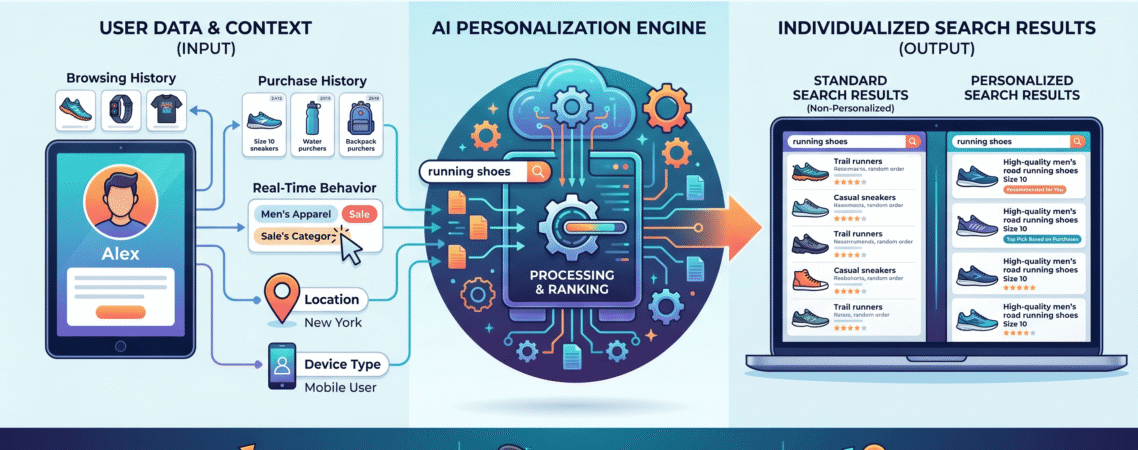
What Is Ecommerce Search Personalization?
Ecommerce search personalization tailors search results for each individual customer using:
- Browsing behavior
- Purchase history
- Search activity
- Product preferences
- Real-time behavioral signals
Rather than presenting identical results to every shopper, personalized search ranks products according to customer relevance while supporting business objectives.
How Semantic Search Improves Ecommerce Personalization
Understanding Customer Intent
Intent is often more important than the exact words customers use.
For example:
A shopper searching for:
“comfortable shoes for nurses”
is likely looking for:
- Long-lasting comfort
- Supportive footwear
- Slip-resistant designs
Semantic search recognizes this broader meaning and surfaces products that satisfy the customer’s underlying need.
Recognizing Synonyms
Customers rarely use identical terminology.
For example:
- Sneakers
- Trainers
- Athletic shoes
- Running shoes
Semantic search understands these relationships and retrieves relevant products regardless of the specific wording used.
This significantly improves product discovery.
Handling Conversational Queries
Customers increasingly search using complete questions or descriptive phrases.
Examples include:
- Best backpack for international travel
- Lightweight jacket for hiking
- Gift ideas for coffee lovers
Semantic search interprets these natural language queries far more effectively than keyword-based systems.
Improving Search Relevance
Semantic understanding enables search engines to rank products according to:
- Query meaning
- Customer intent
- Product relevance
- Behavioral signals
Relevant products appear earlier in search results, increasing customer satisfaction and conversion opportunities.
Leveraging Real-Time Behavioral Signals
Search personalization becomes even more effective when combined with live customer behavior.
Behavioral signals include:
- Recent product views
- Category browsing
- Search history
- Cart additions
- Session activity
Search results adapt dynamically as customer intent evolves.
Supporting Personalized Product Discovery
Two customers searching for the same phrase may have different preferences.
For example:
A loyal premium-brand customer searching for “wireless headphones” may receive different rankings than a budget-conscious first-time visitor.
Semantic search combines intent with customer context to personalize discovery.
Enhancing Merchandising Performance
Retailers can use semantic search to balance customer relevance with merchandising priorities.
Search rankings may also consider:
- Inventory availability
- Promotional campaigns
- Product profitability
- Seasonal merchandising
This supports both customer satisfaction and business objectives.
Improving Zero-Result Searches
Traditional search engines frequently produce zero-result pages.
Semantic search reduces these occurrences by recognizing:
- Similar terms
- Related products
- Alternative categories
- Product attributes
Customers remain engaged even when their original query does not exactly match catalog terminology.
Strengthening Cross-Selling Opportunities
Semantic search identifies relationships between products.
Customers searching for one product may also receive recommendations for:
- Complementary accessories
- Alternative models
- Related product categories
These recommendations improve average order value while simplifying product discovery.
AI Powers Semantic Understanding
Artificial intelligence enables semantic search systems to analyze millions of customer interactions.
AI can:
- Interpret natural language
- Predict customer intent
- Rank products intelligently
- Learn from search behavior
Machine learning continuously improves search quality over time.
The Role of Customer Data Platforms
Customer Data Platforms (CDPs) strengthen search personalization by providing unified customer profiles.
CDPs consolidate:
- Purchase history
- Browsing behavior
- Search activity
- Loyalty participation
- Customer preferences
This information enables semantic search engines to personalize results more accurately.
Supporting Omnichannel Search Experiences
Customers search across multiple digital touchpoints, including:
- Ecommerce websites
- Mobile applications
- Customer portals
- Voice assistants
Semantic search helps ensure consistent, personalized experiences regardless of channel.
Benefits of Semantic Search Personalization
Better Product Discovery
Customers find relevant products more quickly.
Higher Conversion Rates
Search results better reflect customer intent.
Improved Customer Engagement
Relevant experiences encourage longer browsing sessions.
Lower Search Abandonment
Customers are less likely to leave after unsuccessful searches.
Increased Average Order Value
Better recommendations encourage larger purchases.
Higher Customer Satisfaction
Customers experience less friction throughout the shopping journey.
Common Challenges Retailers Face
Complex Product Catalogs
Large assortments require sophisticated search capabilities.
Fragmented Customer Data
Search engines need access to unified customer information.
Real-Time Processing Requirements
Search personalization must respond instantly.
Changing Customer Language
Product terminology evolves continuously.
Addressing these challenges is essential for successful semantic search implementation.
Best Practices for Semantic Search in Retail
Build Rich Product Data
Detailed product attributes improve semantic understanding.
Capture Real-Time Behavioral Signals
Current customer activity strengthens personalization.
Leverage AI-Powered Search Models
Machine learning improves search relevance continuously.
Connect Search with Customer Data
Unified profiles improve search accuracy.
Continuously Optimize Search Performance
Search behavior evolves over time.
Key Metrics to Track
Organizations should monitor:
- Search conversion rate
- Search abandonment rate
- Product discovery rate
- Zero-result search rate
- Click-through rate
- Revenue per search session
- Average order value
These metrics help evaluate the impact of semantic search on retail performance.
Conclusion
Search is no longer just a navigation feature—it is one of the most important drivers of customer experience and revenue in ecommerce. As customer queries become more conversational and product catalogs grow more complex, keyword-based search alone cannot meet modern expectations.
Semantic search addresses this challenge by combining AI, natural language processing, behavioral analytics, and customer context to understand what shoppers actually mean rather than simply matching words. When integrated with ecommerce search personalization, semantic search creates highly relevant experiences that improve product discovery, support merchandising goals, reduce search friction, and increase conversions.
As retailers continue investing in AI-driven commerce, semantic search will play a central role in delivering intelligent, personalized shopping experiences that strengthen customer satisfaction and drive sustainable business growth.


