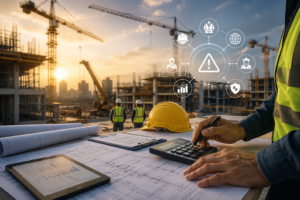
Commercial projects involve considerable amounts of money and resources. Thus, there is a low margin of error while managing budgets. In this high-stakes environment, Commercial Estimating has evolved far beyond basic cost calculation. Today, it serves as an indispensable risk-management discipline that identifies vulnerabilities.
What Are The Most Critical Risks For Commercial Estimating?
To avoid losing money on a project, a commercial estimator must first determine what could go wrong. Large-scale construction projects are subject to many high-impact risks:
-
Material costs can vary dramatically
Geopolitical events, changes in trading policy, or supply chain disruptions due to weather conditions can affect the cost. All of these are the reasons that cause significant fluctuations in material prices. If there is a large increase in material costs, the cost of a project will exceed the market value of the project.
-
Complicated logistics and site conditions
Especially in Commercial Construction, the use of cranes and other large equipment is notably excessive. Thus, construction crews working in densely populated areas face an enormous number of logistical challenges.
-
Labour shortages and declining productivity
The shortage of skilled labour continues to plague the construction industry. The inability to predict the availability of qualified specialty trades, including MEP and framing, etc, is becoming increasingly difficult. Thus, leading to low productivity in the field, which is a significant contributor to lengthy schedules.
-
Design Clashes and Missing Scope
One of the large-scale construction risks is that there can be problems in design and scope. In other words, the design drawings do not adequately represent the spaces between MEP components. The result of these missing or ambiguous spaces in design is that crew members find themselves in an emergency.
How Estimating Reduces Risks
Professionals, such as Universe Estimating, systematically dismantle these threats before ground is broken. Here’s how they do it:
- Use building information modelling (BIM) 5D to perform automated clash detection on-screen to identify structural and spatial trade-offs
- Utilise real-time hyper-local data on the current labour rates for your area and the availability of different materials. This is done by using tools like RSMeans, rather than using outdated national average costs.
- Apply Value Engineering proactively to find alternative superior-performing materials or prefabricated systems. Thus, reducing the time needed to install them in the field. Also, reducing the unpredictability of your project budget caused by fluctuations in labour and material costs.
- Replace the typical 10 to 15% contingency fund percentage with a dynamic risk register that defines targeted contingency funds. These are based upon clearly identified statistical exposures to risk.
Final Remarks
To sum it up, a single catastrophic event doesn’t cause cost overruns on large commercial projects. Rather, they occur as a result of multiple minor risks adding up over time due to a lack of management of those risks. However, commercial estimating provides financial reality to the design stage. It converts an estimate from a mere price tag into a tool of great strategic value. Thus, ensuring that a project is financially protected throughout its life.